Why Epaphras Canopy Foundation Was Founded to Help Ugandans Return Home Safely
-
by
 site-admin.
- No Comments on Why Epaphras Canopy Foundation Was Founded to Help Ugandans Return Home Safely
 site-admin.
For many Ugandans, travelling abroad for work begins with hope. A job in another country may represent school fees for children, a better home for parents, capital for a future business or simply the chance to earn an income that is difficult to find at home.
But migration does not always unfold according to plan.
Some Ugandans working abroad eventually lose employment, experience financial difficulties, face problems with travel or immigration documents, or find themselves living in circumstances they no longer consider safe or sustainable. When that happens, the simple wish to return home can become financially and practically difficult.
This is the problem at the heart of Epaphras Canopy Foundation’s commitment to supporting a safe return for Ugandans abroad.
A mission shaped by first-hand experience
The idea behind Epaphras Canopy Foundation is closely connected to the experience of its founder, George Epaphras Lwanga.
His professional history includes extensive accounting and financial management work in Uganda, Rwanda and the United Arab Emirates. His CV records several years of work in Abu Dhabi, including assignments at Corniche and Al Bateen Beaches and later with SERCO UAE.
Living and working in the region created an opportunity to see more than the successful side of labour migration.
Behind the salaries sent home and the photographs shared with relatives are people whose employment may have ended, whose documents may have expired, whose accommodation may be unstable, or who simply cannot afford the journey back to Uganda.
Women can be especially exposed when employment, accommodation and immigration status are tied closely together.
For ECF, the question became simple: when a Ugandan wants to come home but cannot manage the process alone, who can help create a safe and practical route back?
Returning home should remain an option
Being stranded abroad does not always mean a person has no family, skills or ambition.
Sometimes the barrier is much more immediate.
A person may need help communicating with relatives. Another may need assistance understanding what documentation is required. Someone else may be able to complete the process but lack the funds needed for travel.
Each situation is different.
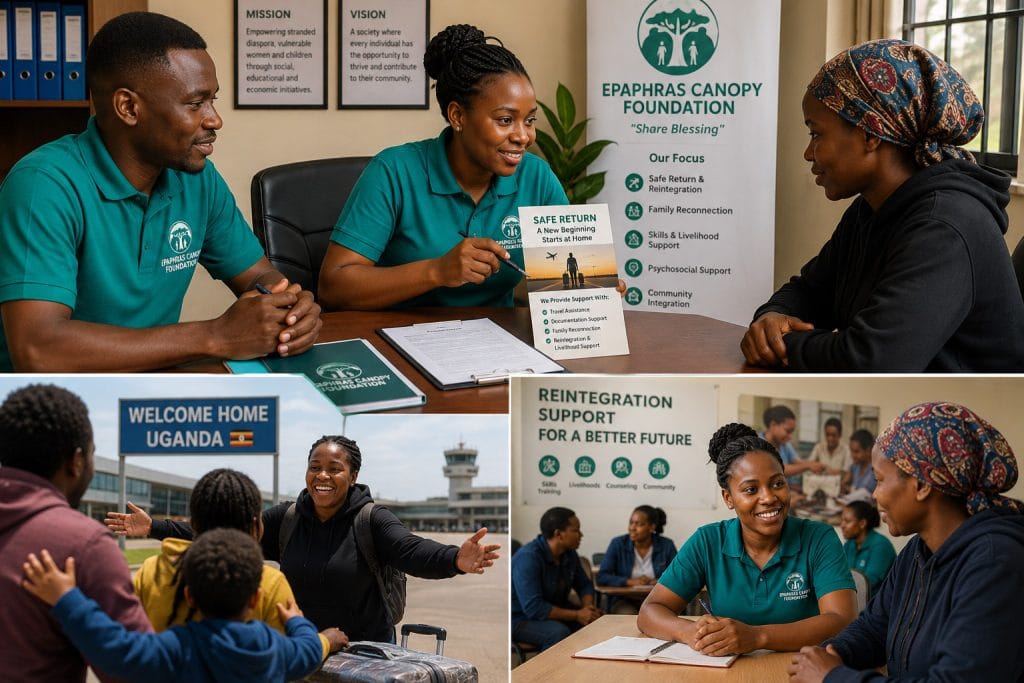
That is why ECF does not treat safe return as a single standard transaction. The intention is to consider the circumstances of each verified case and determine what practical support, coordination or referral may be appropriate.
A safe return may involve communication, case assessment, documentation support, travel preparation, family coordination or assistance toward eligible travel-related costs.
The objective is not simply to move somebody from one country to another.
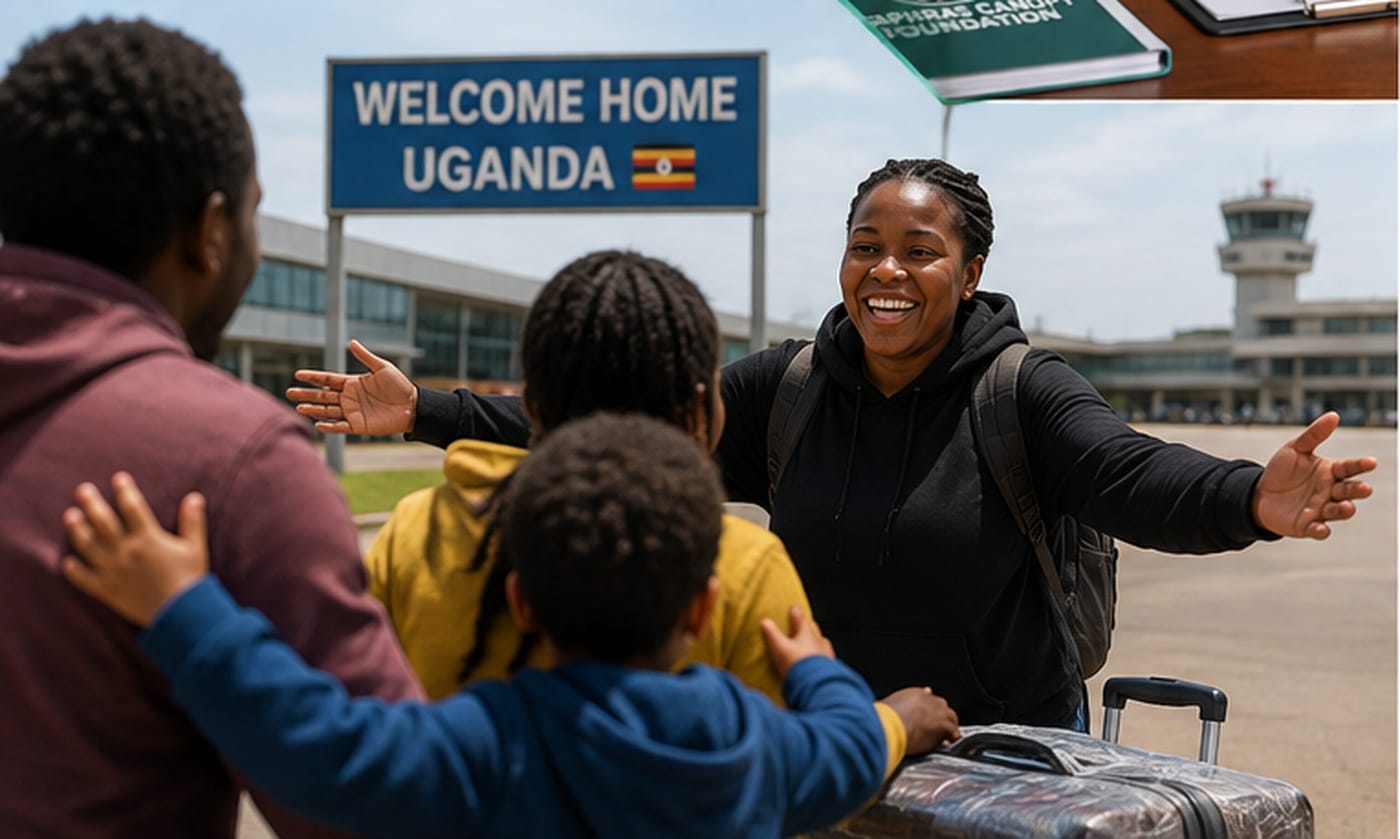
It is to help them return with dignity.
Why dignity matters
Migration difficulties can already carry considerable emotional pressure.
A person may worry about how family members will react. They may have left Uganda with expectations that they would succeed financially. Returning earlier than planned can therefore feel like a personal failure, even when the circumstances were beyond their control.
ECF believes support should avoid adding humiliation to an already difficult situation.
That affects how stories are told, how photographs are used and how beneficiaries are represented.
A person seeking help is not a fundraising prop.
They are an individual whose privacy, choices and dignity deserve respect.
This is also why ECF’s public communication focuses on solutions, safe return, family reconnection and new opportunities rather than publishing degrading images of people at their most vulnerable.
A safe return is not the end of the story
Buying a ticket or arranging travel can solve the immediate problem of getting home.
It does not automatically solve what happens the next morning.
A returnee may arrive in Uganda after months or years away. Family relationships may have changed. Savings may be limited. Previous employment may no longer exist. Children may need schooling. Accommodation may need to be arranged. A person may also need time to decide what comes next.
For this reason, ECF connects safe return with reintegration.
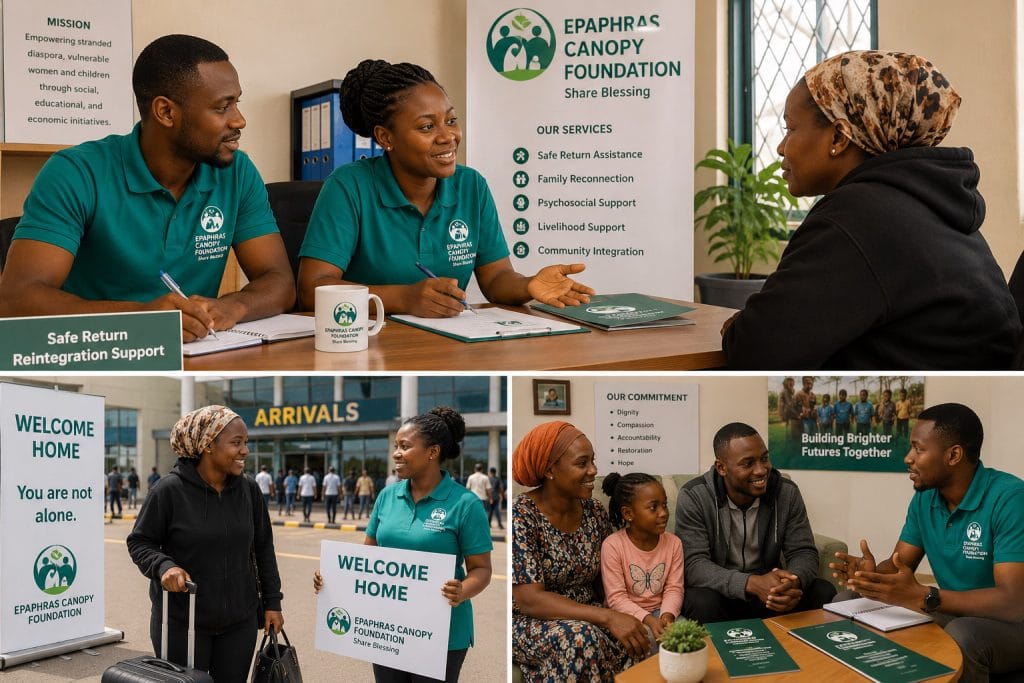
Reintegration means helping a returnee move from arrival toward stability.
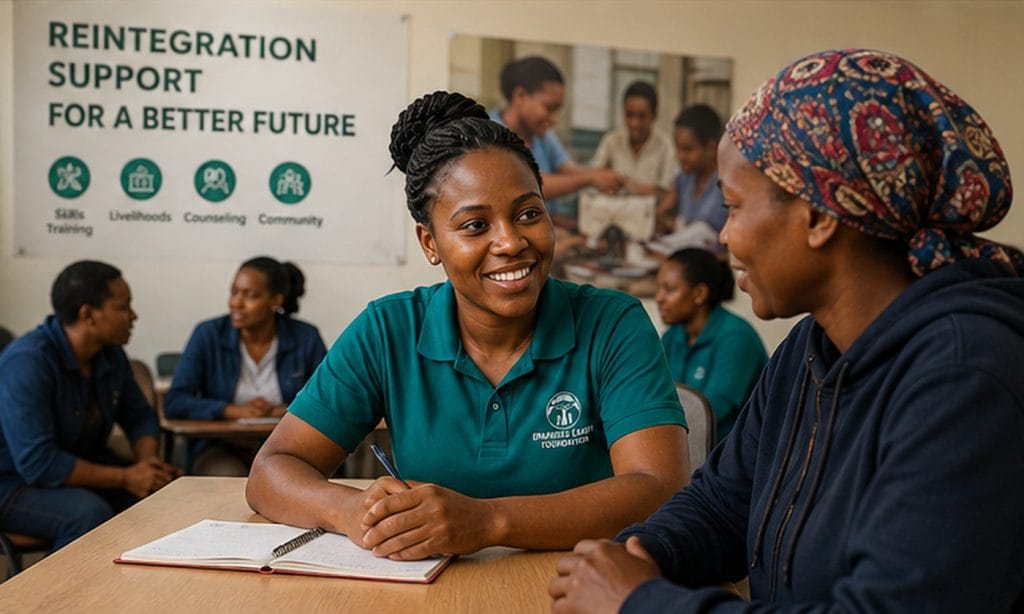
Depending on individual circumstances and available resources, that may involve family reconnection, skills development, livelihood planning, referrals or support toward a viable income-generating activity.
The aim is not dependency.
It is a path back toward independence.
Why livelihoods matter after return
Economic pressure is one of the reasons many Ugandans leave the country for work in the first place.
If someone returns home with no source of income, the same pressure can quickly reappear.
This makes livelihood support an important part of reintegration.
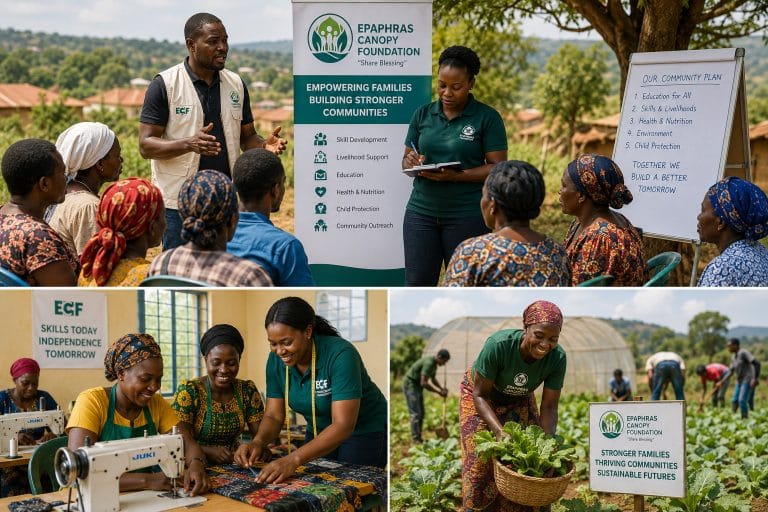
ECF’s wider mission includes social, educational and economic empowerment for stranded diaspora women, vulnerable local women and children. Its organisation profile specifically identifies education,
practical skills and economic opportunity as important elements in helping people improve their quality of life.
For a returnee, livelihood planning might involve identifying existing skills, learning a new trade, developing a small business idea or receiving guidance on basic financial management.
The right response will differ from one person to another.
A returnee who already knows tailoring may need help turning that skill into a small enterprise. Another may benefit from agriculture. Someone else may need vocational training before trying to start a business.
Family reconnection is part of reintegration
Returning home can also be a social process.
Families may have been separated for years. Communication may have become irregular. Expectations about money, responsibility and future plans may be difficult to manage.
Where appropriate, family communication can therefore be part of preparing for return.
The strongest reintegration outcomes are more likely when the individual has a realistic plan and a support system around them.
ECF’s role is not to replace families.
It is to help create conditions in which the returnee can reconnect, make informed decisions and begin rebuilding.
The role of donors
The Sponsor a Safe Return campaign gives supporters a practical way to contribute to this work.
Donations may help ECF respond to verified cases through assessment, documentation-related needs, travel arrangements, reception, reintegration or other eligible programme expenses.
Not every donation pays for one complete return.
Instead, contributions can be pooled so the organisation can respond according to urgency, case circumstances and available funds.
This is important because return costs vary significantly.
One case may require relatively limited assistance while another may involve more extensive travel or documentation requirements.
From an individual return to a stronger community
The benefits of safe return do not stop with one person.
A parent who returns safely can reconnect with children.
A woman who establishes a viable livelihood can contribute to household income.
A returnee who gains practical skills can eventually employ or train someone else.
A person who has regained stability may also become a source of guidance for others considering migration.
This is how safe return connects with the wider community mission of Epaphras Canopy Foundation.
The Foundation’s work extends beyond returnees to vulnerable women, children and families within Uganda through education, healthcare, skills, livelihoods and community-based assistance.
Help make home reachable again
No Ugandan should feel that returning home is impossible simply because circumstances changed abroad.
Epaphras Canopy Foundation wants to help build practical pathways from being stranded to being safely home, and from arriving home to becoming stable again.
If you would like to support this work, you can contribute to Sponsor a Safe Return, learn more about ECF’s safe return and reintegration programme, or share the campaign with others who may wish to help.
A journey home can be the end of a difficult chapter.
With the right support, it can also be the beginning of a new one.